Team & Role
Product Engineering with Maithy Le & Sean Fong
Advised by André van der Hoek and Yu Lu
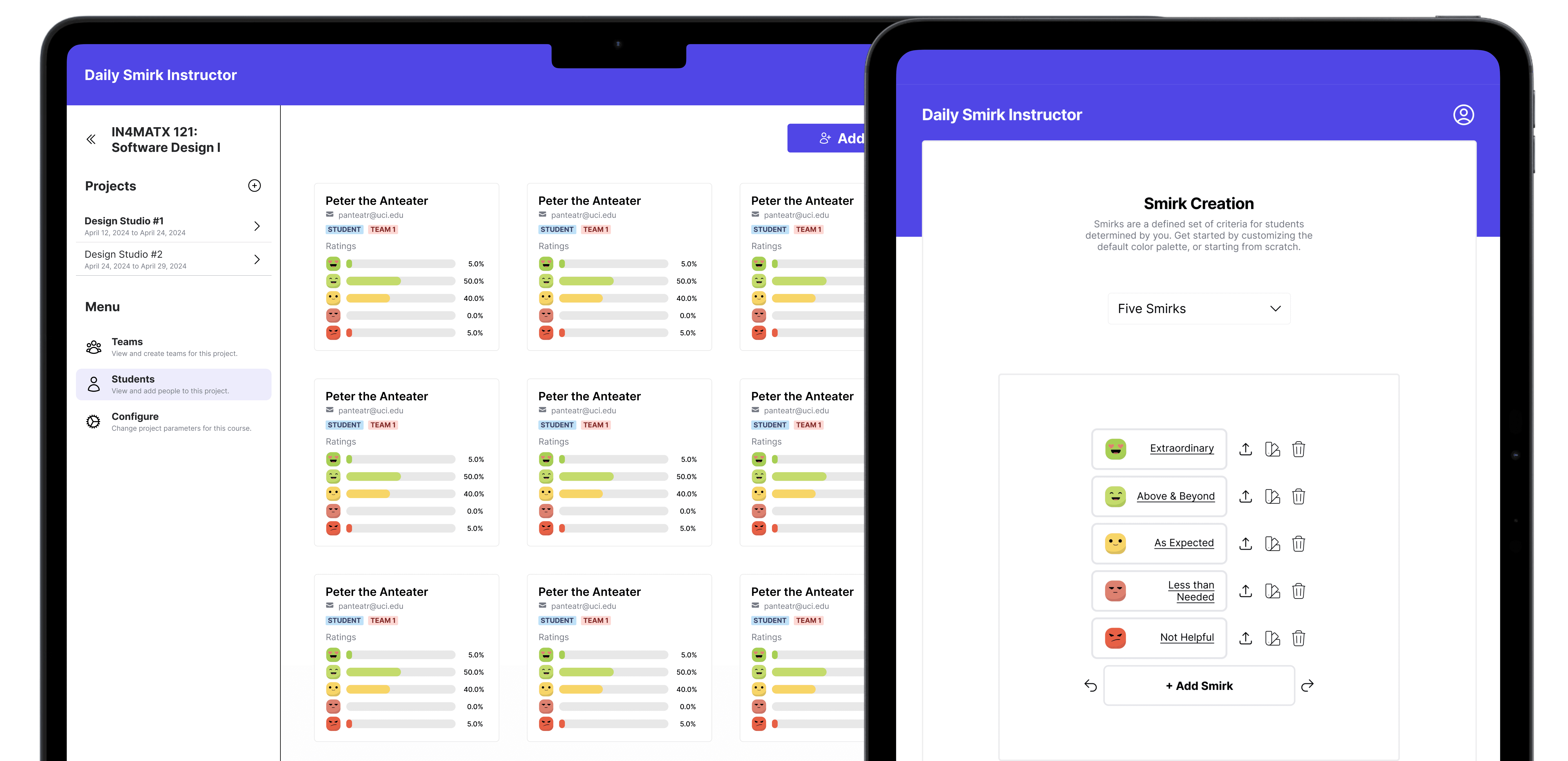
For over a year, I worked on the design and development for the Daily Smirk, a high-frequency peer-assessment tool that allows students to rate and comment on each other during group projects. Instructors are able to view team progress and feedback.
How might we give instructors meaningful control over course and feedback structures while keeping the dashboard simple enough for frequent classroom use?
Design Goals
Enable instructors to create courses and projects with minimal friction while supporting scalable assignments and feedback.
Support the complex dependencies between courses and project settings; smirk and feedback creation.
Enable glance-able insights, so instructors see more and click less.
Minimal Friction
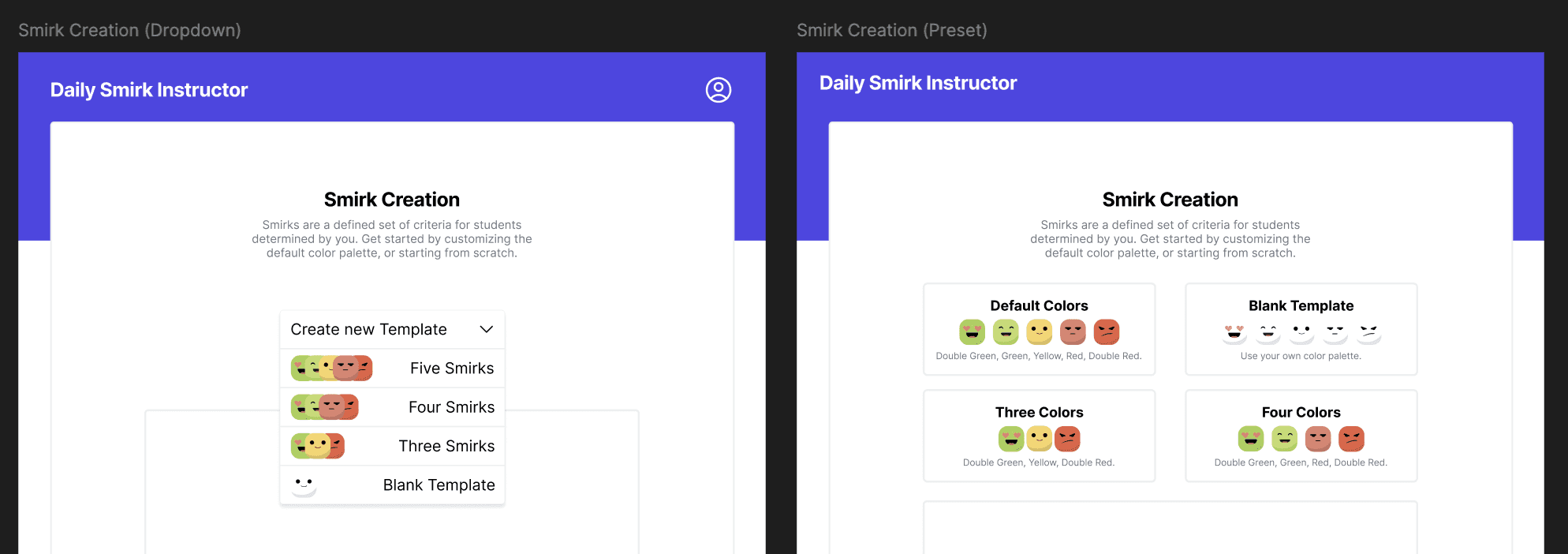
What's in a Smirk? On a technical level, a dependency on associated feedback criteria, and an entry within the database. On a user level, the evaluation method for a team. To support minimal friction for instructors, and anticipation for scalability we decided to go with a drop-down within the flow of creating and defining Smirks.
Glanceable Insights & Scalability
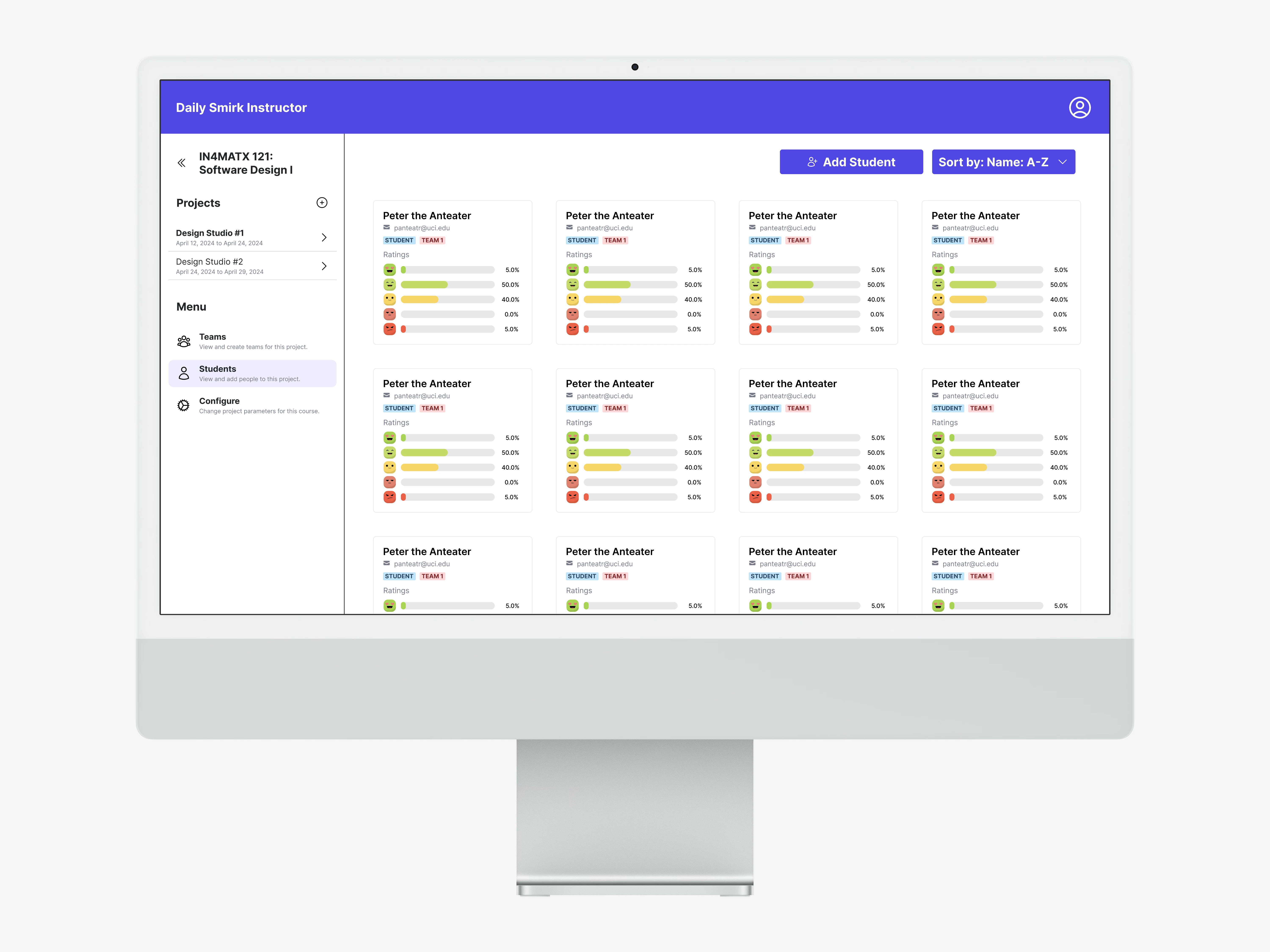
With a new database schema enabling project groupings under individual courses, representing this was key. Through component based design, I first worked on redesigning student cards to maximize the amount of information shown to instructors. Visually, moving away from a singular stacked bar graph to individual bars per rating. Then, I worked on the sidebar informed by different applications in the education and social sphere.
And everything else I did in-between.
My formal role for this project was "Undergraduate Research Assistant" but Product Engineer better captures the work I did, as I was working towards my bachelors degree in Software Engineering.
Oversaw design and development of the instructor-facing dashboard by facilitating stand-ups, sprint-planning and retrospectives.
Collaborated with the entire research team to redesign the database schema, using Miro and Figma.
Presented my inital work at the Undergraduate Research Opportunity Program (UROP) Symposium.
Tinkered with Claude between the design and development process to produce code and ideate.
Conclusion
Daily Smirk is currently deployed at the University of California, Irvine in the Department of Informatics. Currently used in classes ranging from Software Design to the Senior Capstone class.